
Words in the wild
In which my strategy is showing.
Some of my strategy words are being put to use, verbatim, in public.
But first… Nick Cave gives brand strategy advice to Kylie
I watched the Kylie documentary on Netflix. It’s clearly her film. She’s in control of what’s said about her and what’s shown of her and what’s not. And she doesn’t try to hide it. I hoovered all three episodes - I found it compulsive viewing - but I think the transparent manipulation is a valid gripe. I like to have my heartstrings tugged, but I don’t want to see the ropes and pulleys. But perhaps it’s fair enough. Perhaps it’s payback for all the bad stuff she had to endure when she had no control. Anyway, Kylie is just so damn infectiously likeable that it works regardless.
Toward the end of Episode 2, Nick Cave rescues Kylie from herself. She’s trying to shed her pop persona in a bid for credibility. But her flirtation with a more Indie image isn’t going well. Cave does for her what any good brand consultant does for a client. They see the truth from the outside and they give their client the confidence to inhabit that truth with a sense of liberation and gusto.
Cave tells Kylie that she’s a prisoner of the Indie image she’s chasing. He tells her that she is, was, and always will be a pop star. She just needs better pop songs, with better lyrics. Her lyrics. He recognises that she has things to say for herself, and encourages her to put them into song, rather than have other people’s thoughts come out of her mouth.
And she listens:
You’ve got the coolest guy on the planet saying, “Where’s the pop tunes?”
Right, let’s get the jetpacks on and get back to the dancefloor.
Kylie Minogue, Episode 2, Kylie (Netflix)
And that’s what she does. She releases banger after banger after banger. It’s quite the turnaround.
This is the irresistible truth of Kylie according to Nick Cave:
What the fuck are you doing? Indie? No one willingly wants to be Indie. They may say they do. But that’s not what Kylie is. Kylie is this force that’s there to affect thousands and thousands and thousands of people. It’s all outward. It’s all giving.
Nick Cave, Episode 2, Kylie (Netflix)

Viva purpose (words in the wild)
One of my clients published its first impact report recently, with my work front and centre on page 2. (Bottom left of the page if you want to be pedantic.) Here’s some back story.
Trying to sell a brand on the basis that it has some higher purpose is getting a bad rap in marketing circles. There’s an anti-purpose backlash going on in the LinkedIn bubble. Some of that is justified, especially when mass-market consumer brands forget themselves and take it too far. But purpose has a place. It definitely has a place if you’re an organisation that provides a service to purposeful businesses.
Firstport is the agency that channels government funding and provides advisory support to social enterprises in Scotland. And, by definition, every social enterprise is a purpose-led business.
Firstport hired Korero Studio to overhaul its brand identity, and Korero subcontracted the brand strategy work to me.
I got to speak to lots of social entrepreneurs, which was its own reward. There are beautiful people doing wonderful things all across this land. Many of them are sensitive people; vulnerable people; people who’ve fallen into social enterprise because conventional workplaces feel alien to them, or even hostile. Social entrepreneurs over-index on neurodiverse diagnoses, for example.
And they have a love-hate relationship with the whole premise of business and profit. They have to make money to create sustainable jobs. They have to make money to tackle the social and environmental causes that they care about. But profit can also feel grubby.
Social entrepreneurs need the right kind of help. They also need the right kind of handling. Firstport excels at both. And its brand needs to reflect this.
I tend to steer clear of vision and mission statements. Most of my clients don’t need them. And it’s too easy to make a bad job of them. People think that these statements should be co-created, which leads to the worst kind of consensual process and a vapid box-ticking exercise.
Firstport was different. Vision and Mission statements are useful to them. They are essential tenets of the organisation’s identity. They’re vital in every sense.
I wrote the statements below for them based on what I’d learned from Firstport and its social entrepreneur clients. They embraced them without changing a word. I think they felt seen.
A meaningful vision gives people something worthwhile to believe in and belong to. It gets them out of bed in the morning.
An active, functional mission gives people something concrete and beneficial to focus on. It’s the day job.
Firstport vision:
A society in which doing business is synonymous with doing good
Firstport mission:
To make social enterprise accessible, achievable and aspirational
Firstport proposition:
The first port of call for social entrepreneurs
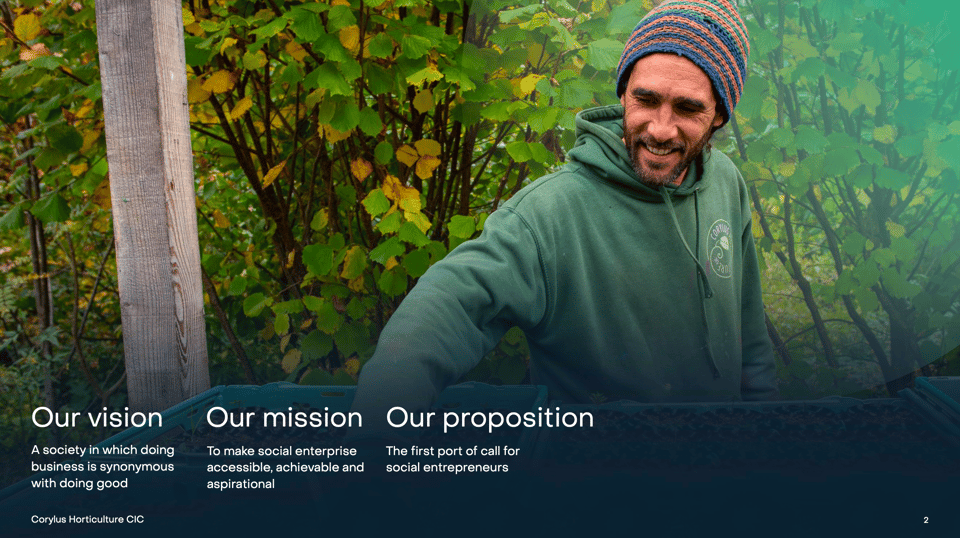
I was in two minds about the alliterative mission statement. Alliteration makes things easier to remember. But it can come across as slick and tricksy, which reduces credibility. Alliteration works in this case because each of those words - accessible, achievable, and aspirational - directly addresses a specific barrier that this sensitive group of people has to overcome in order to start a social enterprise. I didn’t have to sacrifice meaning for memorability, or vice versa.
As for the proposition, this was Nick Cave-style consulting. This was pointing out the obvious to people who were too close to see it for themselves. You’re called Firstport because you’re the first port of call for budding social entrepreneurs. You offer the financial and sensitive moral support they need at the outset, when they’re at their most fragile and tentative. The first port of call thing was so crazily obvious from the outside. But not from the inside. You can’t read the label from inside the bottle.
Positioning is leadership
I’ve been thinking about how to get more work. Not more work per se. More of the right kind of work. The type of work that my clients and I get the most out of.
I decided that the first step is to give that work a name.
It’s the kind of brand work that’s much more than marketing. It’s more CEO than CMO. It’s two-faced work in that its internal effects are as important as its external impact. Finding a brand’s irresistible truth makes sense of the business behind it at the same time as making its shop window work harder. In his excellent book, Strategy is a Verb (see below), Martin Weigel describes this as brand strategy of “the full fat, business enveloping, stakeholder aligning kind”. Yep, exactly that.
The heart of this work is positioning, which is a more concrete, more commercial, more CEO-friendly concept than brand strategy. Done properly, positioning is too upstream, too strategic, for a CEO to leave it to anyone else.
And it struck me that the common premise behind my favourite projects is that positioning is leadership by another name.
Positioning is leadership is the working title for the work I want more of.
A premise with promise?
On its own, Positioning is leadership is just a pithy assertion. So I’ve added some logic to give it depth and make it feel like a supportable premise.
I nicked an idea from Nonfiction Research to do this. Nonfiction is a research agency I’ve never worked with, sadly, but which I admire greatly from afar. They frame each project with what they call a “burning question”, the answer to which has great value to their client. To make sure that the answer is as strong as the question, at the end of the project they prepare what they call a “five-liner”. The five-liner is a compact, coherent, compelling summary of the work. And Nonfiction’s criteria for a valid five-liner make it an acid test for logic and clarity.
Whoever's leading the project prepares what we call a five-liner. And it's basically five simple sentences that summarise the insights of the project, and the story that we feel is the solution to that burning question. We're really brutal at making sure that each of those sentences is supportable. And that each follows from the other one. And that it goes somewhere that the client doesn't already know.
Gunny Scarfo, Co-founder, Nonfiction Research, On Strategy Showcase, 8th July 2023
Here’s my first-draft five-liner for Positioning is leadership:
A leader is someone whom people gladly follow, which is not the same as someone with a C in their title.
If you want to be gladly followed, you need to make sense of things and give direction, such that progress feels both feasible and worthwhile.
Positioning is the answer to two sense-making and direction-giving questions: what are we great at and who cares (i.e. to what are we dedicated and to whom are we dedicated)?
Positioning is leadership because it works inside the organisation to make sense of the business, sharpen the elevator pitch, and give people something to believe in, belong to, and get behind.
Positioning is leadership because it works externally to create strong preference amongst buyers, which translates into robust demand and pricing power, which lead to sustainable profit.
Is this a premise with promise?
How does it land with you, especially the founders and CEOs among you? I’ve had fun working with it - always a good sign - and I have a bunch of draft LinkedIn posts and some outreach ideas to bring it life in public. But I’d welcome your observations in private first. Any flaws in the premise? Any kinks in the logic? Anything I’ve missed that would make it stronger? Any questions it raises? If you have any observations, you can share them by replying directly to this email. Thank you.
Postscript: more words in the wild
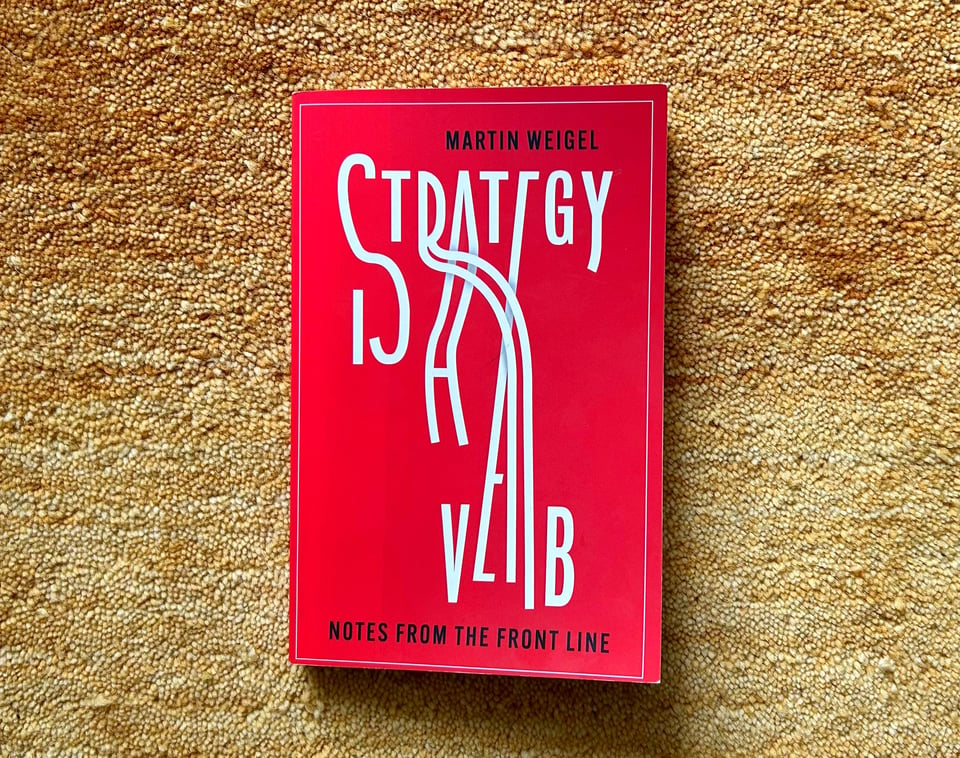
Strategy is a Verb
Martin has some words in the wild too. He’s written a book.
Martin knows what he’s doing and he knows what he’s about. I created an RSS feed from his blog to make sure that I never miss any of his posts. So of course I bought his book.
Strategy is a Verb is a book of 58 verbs actually, each one epitomising an aspect of Martin’s outlook on strategy. It’s more philosophical than practical. But, if anything, that makes it more useful, not less, than most strategy books. Rather than telling me how to do the work, it fired me up and left me wanting to go out and do the work. And do it properly. It’s the strategist’s equivalent of a half-time team-talk from one of the world’s best coaches.
I see eye to eye with Martin on the importance of imagination, narrative, and excitement in strategy. He’s gone and put those beliefs into some most excellent, verby words.
-
Felicitous words Phillip. Must catch up some time. Jimbo
-
Thanks Jim. I'll message you about a catch up.
Add a comment: