
The logistics of mercy
In which I borrow language from another category to reposition a client and set them apart.
But first… a lesson in pitching
Back in my payroll days, when recruitment was part of my job, I was a sucker for people who had a different way of looking at the world. Anyone who’d seen something I hadn’t seen and made it feel profound; anyone who made me look again and reappraise something I’d taken for granted; anyone with an eye for quirks of culture or human nature; I’d forgive them their interview trespasses and at least invite them back for a second conversation. In advertising, if you meet someone who can make any mundane topic feel novel and interesting, you snap them up.
The energy that aces interviews also wins pitches. If you can make a prospective client see their business in a novel way, such that its future feels much brighter, they’ll want to snap you up too.
In this business, you hire for novel perspectives. And you win pitches with novel perspectives. You hire visionaries and you win with vision.
Every imaginative vision, every idea, has an inherent tone. A physicist would call this the “natural frequency” of the idea. And when the tone or the natural frequency of a presenter matches the inherent tone or natural frequency of the idea they’re presenting, you get what a physicist would recognise as resonance. You get a self-amplifying system; the visionary and their vision draw strength from each other to form a resonant feedback loop. It’s a sure-fire winning combination.
So elite pitchers match their tone to the inherent tone of the idea they’re pitching. They captivate their audience with a novel perspective that feels authored. It could only come from this person or these people.
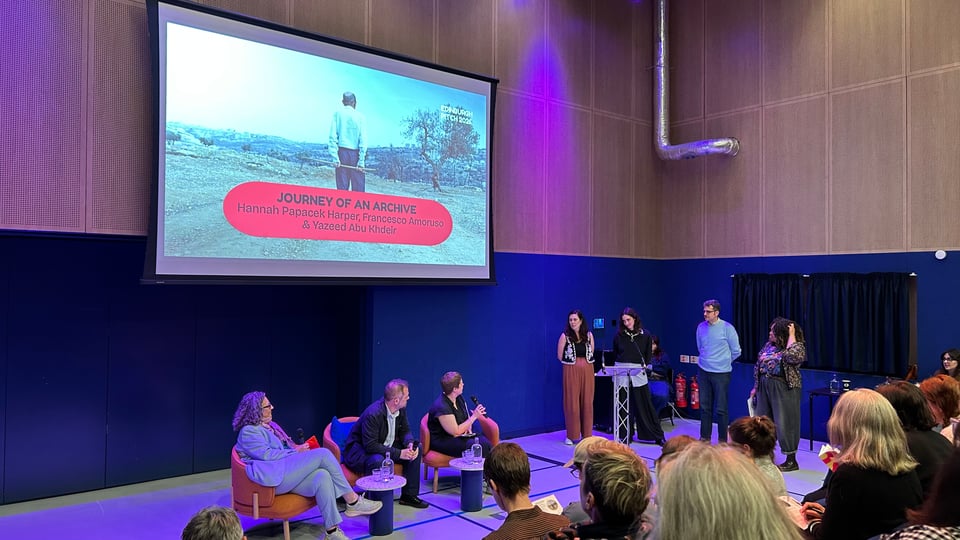
I saw this happen recently when I attended The Edinburgh Pitch, an event produced by Scottish Documentary Institute (disclosure: I’m an SDI trustee). Twelve documentary projects pitched for funds, partnerships, and distribution to an A-list panel of documentary funders, partners, and distributors. In front of an audience. Cool.
Each of the teams had workshopped their pitches with expert coaches the day before. So their loglines were tight and intriguing. Their trailers provided proof of concept, proof of aesthetic, and proof of momentum. The urgency of each idea, the need for each story to be told, was palpable. And you could feel the intense personal connection of the filmmakers to their projects. The standard was high across the board.
But still a few pitches stood out. These were the ones where the energy of the pitcher resonated with the aesthetic of their film.
The public pitch event was followed the next day by private meetings between the filmmakers and the industry panellists, with the potential for deals to be done. Who knows what happened behind closed doors? Good things hopefully. But two projects were awarded cash prizes in public: one voted by the event audience and one voted by the industry panel.
The winner of the industry award was a project called Anything But Love by Chinese director Zijian Zeng. The trailer for his film was, by turns, melancholy, funny, absurd, and heartbreakingly raw. And Zijian’s pitch took us on a similar tour of emotions. This was him. This could only be his film.
To respect the filmmakers’ confidentiality when their projects are in development, I’m only allowed to share details that the filmmakers themselves have shared in public. Here, below, is what Zijian wrote when he won the award. The tone of his post is the tone of his pitch. Proud and embarrassed at the same time. Feeling inadequate in his world. Feeling inadequate pitching against projects from the front lines of conflict, colonisation, and climate breakdown.
This film began from something I used to think was too private, too embarrassing, maybe even too small. The feeling of being a queer man in China who has never really been loved…
…there was my film, asking what a person does when love is not given to him.
But maybe that is also urgent.
The need to be touched, held, seen, chosen, remembered. The shame of wanting love too much. The strange things we do when intimacy is not freely available. These are also part of the world we live in.Zijian Zeng Instagram post, June 2026
A novel perspective that could only come from you. That’s the secret. That’s the pitching lesson.
The logistics of mercy
Here are some more of my strategy words in the wild. A brand idea that’s putting in a shift across all of my client’s comms.
Human Appeal is a Muslim aid charity. It provides disaster relief and builds vital infrastructure in vulnerable communities.
Its USP is that it stays hands-on from the receipt of donations to the delivery of aid in situ. It doesn’t outsource. It doesn’t sub-contract. It’s the aid equivalent of farm-to-plate. Only the plate is places like Gaza, Sudan, and Lebanon.
Human Appeal had always done well by generating donations through standalone appeal campaigns. So-called performance marketing had done the job for them. But increased competition from other charities, including the likes of Oxfam encroaching on traditionally Muslim appeals, had significantly reduced the effectiveness of these one-off campaigns.
Human Appeal needed a brand idea that positioned them as the charity of choice for Muslim donors; a brand idea that would add cohesion to its appeal campaigns and create a compounding effect over time.
I came up with the brand idea by combining two observations.
The first was a reframing of Human Appeal’s USP. Their hands-on, end-to-end, stewardship approach made me think of logistics companies. Human Appeal is in the aid logistics business. They are the FedEx of disaster aid.
The language of logistics is all about urgency, service commitments, and a duty of care. To show the power of this language, I wrote a series of logistics-style service commitments for Human Appeal. There’s a bionic effect when you transplant logistics words into a charity brand.
The second observation was that “mercy” is a heavily loaded word for Muslim people. Asking Muslims to give mercy when they donate turns the transaction into something more noble and textured, with layers of spiritual meaning.
So Human appeal is in the mercy logistics business.
We expressed this reframe as a brand idea:
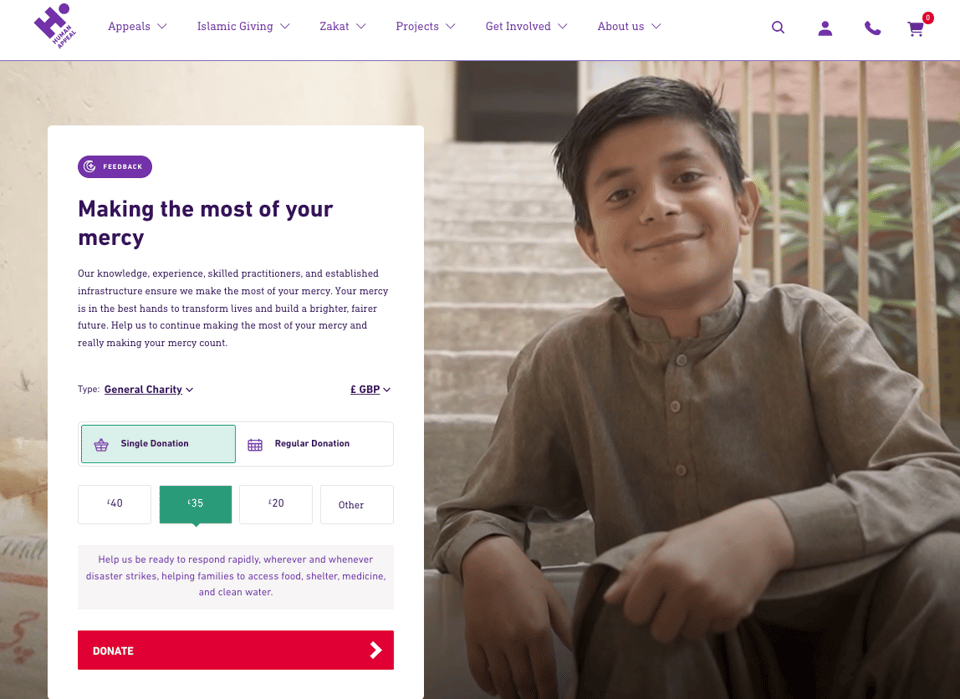
MAKING THE MOST OF YOUR MERCY
The brand idea works horizontally across all appeal campaigns to make sure that the whole is greater than the sum of its parts.
And it works vertically within each campaign, linking the pre-appeal trust-building phase (we’ll make the most of your mercy), the fundraising appeal itself (these people need your mercy now), and post-appeal thank-you messaging and impact reporting (your mercy made a difference/this is how we made the most of your mercy).
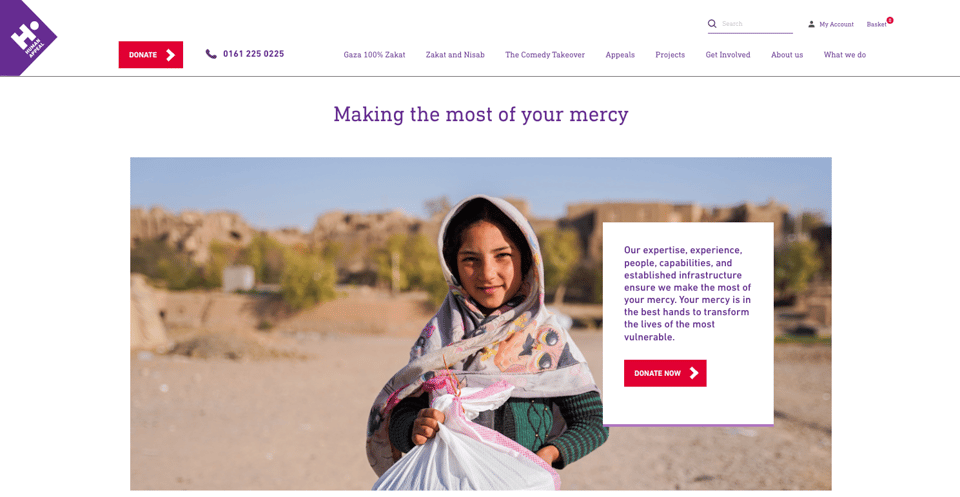
Making the most of your mercy has brought branding coherence to Human Appeal’s comms for four years now. It’s the irresistible truth of Human Appeal and it makes their appeal campaigns work harder. It’s what we would have called a “brand response” idea back in the day.
I was introduced to Human Appeal by their then performance marketing agency, Solja, who don’t have a website I can link to. (They’re so good that all their work comes from referrals.) All credit and many thanks to them for highlighting the need for a greater emphasis on branding.
Postscript: (NonExec)2
I’m two board meetings into my first paid non-executive directorship, on the board of a company that was previously a brand strategy client. It’s an advisory business, which is a sector I know well. I worked in and managed advisory businesses for nearly thirty years. And, as an independent consultant, I’ve been an advisor to several advisory firms.
Nonetheless it’s a peculiar transition. As a consultant, you’re paid to advise in a specific domain from the outside. As a non-exec, you’re paid to question everything from the inside.
Some skills are useful in both roles: good listening, good questions, intelligent naivety, looking under stones, and playing the heretic if it helps to do so.
I’ve been an unpaid trustee of two arts charities, and the Chair of one. So I knew what to expect in general terms. Nonetheless, it’s still a novel experience in many ways. I’m back on someone else’s payroll for the first time in over six years. And I’ve got a company email address. So I see the all-staff emails, which give a new perspective on culture that I didn’t have when I was consulting. It’s interesting to see what is and isn’t included in board papers. It’s interesting to see which issues people latch onto and which they leave alone in board meetings.
I have capacity to take on another paid non-exec role. The ideal would be another b2b service business. Perhaps even another, non-competitive advisory firm. I can see how a second non-exec role would make me more effective on behalf of both boards in a cross-fertilising, multiplicative way.
NonExec x NonExec or (NonExec)2.
If you know someone or if you know someone who knows someone in the right kind of company, who’s looking for non-execs, please keep me in mind. Thank you. This is the second time in two newsletters I’ve asked for a favour. I promise not to make a habit of it.
-
Every one of these posts seems to contain at least 1 beautifully worded nugget of wisdom Phil.
"A novel perspective that could only come from you".
Fabulous. So simply put but quite hard to do (much like "it's very you .. and also very them"
-
Thanks (again) for your explicit support David. People seem much less inclined to effuse than they were in the good old generous days of Twitter, so this means a lot.
Add a comment: