
Spanner amnesty
In which there are three timely interventions.
Flushing and forgetting
One of my clients held an AI amnesty recently. They employ hundreds of inquisitive people in a culture of innovation and initiative. It’s the ideal environment for AI to spread its spores. The fungus analogy works. By the time blue mould appears on the top slice of bread, it apparently means that the mycelium network has already spread through the whole loaf. Likewise, if you suddenly find yourself dealing with AI clangers, it’s a sure sign that everyone is using AI for something, and that most people have been using it for a while.
My client had all these people using an unknown variety of AI tools, of unknown origin, in all sorts of unknown ways. It was way beyond curious dabbling. Many people had routinely adopted some form of so-called AI into their daily work. But it was unstructured and undocumented. It had a distinctly grey market feel to it. The company didn’t know for sure who was using which tools to which ends and at what risk. And it was clear that something was off. Quality alarms were starting to sound. Shoddy work, produced by AI tools, was being intercepted just before it was shipped to customers.
This organisation is really good at what it does. Most of its revenue comes from repeat business and referrals. They don’t do shoddy. In fact they’re in the middle of a company-wide review of quality to avoid complacency and raise their game. What even is quality in their business, from first principles? How do you measure it without destroying it? What does better quality look like? How ironic, then, for this review to coincide with so-called AI taking them down the slippery slope to sloppiness.
Hence the AI amnesty. Tell us what you’re using, and what for, so that we can audit, assess, clear the decks, and reboot with a sensible, company-wide AI policy. It’s quite the thing, this idea of an amnesty; applying the same remedy to AI tools in a business that you’d apply to knives, guns, or drugs in wider society. It’s the first I’ve heard of such a thing, but I bet it’s happening a lot.
The word amnesty shares its etymology with amnesia. Of course it does. An amnesty is a process of flushing out and forgetting. You flush out what could be a major problem for the group by promising to forget the minor misdeeds of individuals. It’s an elegant, win-win solution to a pernicious problem. A well-managed amnesty gets the bolted horse back in the barn and lets you shut the door behind it.
Amnesties are cool.
An amusing but subversive ruse
In my digital days, my agency worked on some seriously big technology projects. It was all very “enterprise”.
I wasn’t much use on these occasions. I had just enough technical knowledge to be dangerous. And I had the wrong kind of project management skills. Account managing the production of adverts does nothing to prepare you for the arcane world of Agile project management. I was a stranger to the ceremonies. No one had taught me the secret scrum-master handshake.
However, I was pretty handy at the nebulous art of “stakeholder management”. So they sometimes dropped me into a kick-off meeting to do a turn. This usually involved some kind of court jester routine, in which I’d use an amusing but subversive ruse to get people to say what they really thought before we spent any money; before their hidden agendas turned into expensive problems later on.
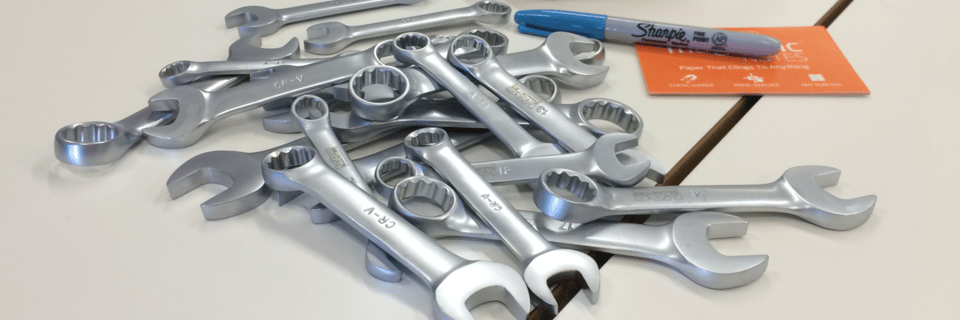
One such ruse was the spanner amnesty. Show me a stakeholder for any change project and I’ll show you a potential feet dragger or spanner chucker. Every project has at least one. Sometimes there are enough spanner chuckers to form a Resistance. It’s tempting to pretend that they don’t exist rather than confront them; at least at the beginning it is. Just know that spanners will be chucked, probably when you can least afford it. Preempting is better than pretending.
The spanner amnesty forces people to drop the pretence. There’s a pile of spanners in the middle of the table. They’re conspicuous. They have an almost animate presence. Their impact is visceral. I bought a set of quality, high-density spanners. People can’t resist picking them up and testing the weight in their palms. You can see what they’re thinking. You could kill Colonel Mustard in the library with one of these. The spanners have heft, just like the unspoken, project-stalling issues they represent.
Getting spanner chuckers to chuck their spanners in public, in a workshop setting, is all in the set-up. It’s one part flattery and one part ultimatum.
Everyone gets a spanner. Then you point out the obvious: that the spanners are a metaphor for each person’s power to disrupt, delay, or destroy the project. You make eye contact as you respectfully acknowledge the dark agency in the room. You tell a couple of true horror stories about the awful consequences of late-project spanner chucking.
Then you invite people to hand the spanners back, one by one. This is the amnesty. You make it a somber and significant moment. You can hand the spanner in silently if you’re fully on board with the project and its premise. But if you have a spanner to chuck, now is the time to chuck it. Chuck it now when it will do least damage and when the audience is most receptive. Chuck it now with everyone in the room so that we can have a constructive conversation and improve our chances of success. Having taken part in this public amnesty, you will look like a right chump if you had a spanner to chuck but deliberately chose to chuck it later. And you will be treated like a chump. Done well the spanner amnesty feels like a rite. Don’t be a chuck chump.
A candid pre-mortem like this can be rough and raw, but it’s better than an autopsy that’s full of recrimination and regret. A spanner amnesty removes dangerous political contraband from the streets of your project before you set off.
Did I mention that amnesties are cool?
Workshop prologues
One time they asked me to run some workshops to generate user stories for a new section of a banking platform.
I was happy to do this because it was an appropriate task for a workshop: everyone with relevant knowledge in the room, breaking the job down into its component tasks, listing, sorting, prioritising, reviewing, fine tuning. A team format for a team sport.
It also helped that I had a decent idea of what a user story was. At least I thought I did going in.
This changed when I did my due diligence. I read some stuff about best practice for writing user stories. This made things less clear rather than more. I found several schools of thought as to the ideal structure and content of a user story. So then I talked to various UX people, project managers, and developers about what they looked for in an ideal user story. Again, opinions were divided on important philosophical and practical issues.
The client team was based in our office for the duration of the project, in a makeshift war-room. User stories that they’d written for other sections of the platform were posted on the walls. There was no uniformity here either. The client didn’t have a house style for user stories.
I could see what was going to happen if I wasn’t careful. We’d spend half of the first workshop debating what a good user story looks like, which would be frustrating, and which would reflect badly on me as the facilitator.
I hate being hapless. So I called a meeting with the client team a couple of weeks before the first workshop. And I facilitated a prologue discussion to arrive at a Gold Standard for user stories that we’d use in the workshops proper.
They enjoyed the session. It was a conversation they needed to have, and they knew it. I think it came as a relief. Clarity and unanimity have that effect, particularly after a long period of niggling, unspoken ambiguity
With that out of the way, we battered through the user story workshops without hindrance.
I manufacture a prologue session before every workshop I run. I insist that everyone who’ll be in the workshop has to attend. We talk about desired outcomes. We resolve issues that would waste time on the day. We talk about things people love and hate about workshops. I get a sense of personalities and team dynamics. I get a feel for what will and won’t work in the room. And it means I don’t have to waste time or take a risk with one of those zany warm-up/intro exercises.
Facilitating a workshop with people you’ve never met is unnecessarily stressful. It’s less effective too. Prologues are cool.
![Screenshot of an email, which reads as follows:
Morning Phil. I wanted to say a special thank you to you for an excellent job leading and facilitating us across the [word redacted] workshops. I believe that we've (finally) made a great start to a project that we've been talking about for months but have been unable to move forward. Great to see that changing now. Much appreciate the time, effort and poise that you brought. Kind regards. [Name redacted]](https://assets.buttondown.email/images/7fe9cc05-5ab9-4f96-a56d-eba16cfadb8e.png?w=960&fit=max)
Add a comment: