
Estranged bread fellows
In which someone is only a stakeholder if they feel like one.
They call me the ponderer
One of my clients runs an academy for people they’re pinning their hopes on as future leaders in the business. It’s a programme of coaching, projects, and workshops that explores topics like leadership, strategy, and communication. They’ve asked me to run a session.
So I’m thinking about this stuff more deeply than usual.
A funny thing happens when you ponder. Useful stuff just seems to bubble up and present itself to you. It keeps happening. It’s like the universe wants to help.
If only that were true. But it’s just a story you tell yourself to explain what happens when your subconscious is on higher alert. The Force isn’t with you. You’re not getting luckier. You’re being extra attentive and noticing more.
It’s not cosmic or karmic, but pondering is good. It’s unpredictably productive.
Pondering made me notice this:
Nearly 80% of Finns say they would defend their country if attacked. In Britain, the figure is closer to 33%. That gap is not an accident. It exists because Finland has spent decades building a society in which people have a genuine stake in what they are being asked to defend. Energy is affordable. Housing is available. Public services function. Institutions command trust. The Nordic welfare state is not a sentimental add-on to Finnish security policy. It is the foundation of it. You cannot ask people to defend a country that does not work for them.
Clive Lewis (Labour MP), Byline Times, 10th May 2026
Finns are happy to be asked what they’d do for their country because their country asks what it can do for them.
A downer that should’ve been an upper
If you take those statistics and what Clive Lewis says about them at face value, the social contract works in Finland. This tallies with everything else I’ve heard and read about the country, so I’ve no reason to doubt it. Finland appears to have a compelling Citizen Value Proposition (CVP) that actually works.
Another client asked me to cast an eye over work they’re doing on their employer brand, including a new Employee Value Proposition (EVP).
These value propositions have to overcome the cynicism of the people they’re meant to please. The cynicism is entirely justified in most cases. CVPs and EVPs are instruments of politics: national politics and office politics respectively. When they work they’re effective policies. When they don’t they’re empty spin; a fancy name for fanciful ideas that have no real commitment behind them.
What you don’t want, but often get, is an HR pet-project that’s disconnected from company strategy and the public-facing brand. You get an EVP that sounds great but never goes anywhere because it lacks board-level intent.
This kind of employer brand work makes things worse rather than better. It draws attention to the gap between how things should be and how they are. Employees feel bad. Management looks bad. The EVP is a downer that should’ve been an upper.
Estranged bread fellows
Etymologically speaking, the word “company” derives from Latin and the idea of “bread together”. A companion is a “bread fellow”. A company is a band of bread fellows. The ideal company feels like a fellowship.
The etymology of fellowship suggests a shared stake in something. So, etymologically speaking, a company should be a band of bread-fellow stakeholders.
We all know that’s easier said than done and therefore quite rare. It’s why the same old usual suspects get trotted out as exemplars.
Stakeholder is one of those business words that gets thoughtlessly bandied around. It’s a label that’s slapped onto people regardless of how they actually feel. I’ve done plenty of so-called stakeholder interviews in which the so-called stakeholder has clearly checked out or never checked in to start with. They’re disengaged, uninvested, and conspicuously empty-handed in the stake department. Don’t talk to them about “employer brand”. Don’t get them started on E, V, bloody P.
It might just work
What would have to be true for an EVP to work as intended and not backfire? What does it take for employer brand theory to translate into concrete and compelling action? What does it take to create a band of bread fellows?
These are the common factors when I’ve seen an EVP programme work as intended:
It comes from the top. It’s backed to the hilt by the top brass.
It’s backed by the board because it’s been proven, or because it’s taken as read, that making everyone feel like a stakeholder is a better commercial decision than not bothering.
It’s relatively low on theory, and all the theory leads to action.
The EVP is a sincere expression of the culture. And it’s visibly, tangibly part of the culture. It’s not just good on paper, you can see it playing out.
The employer brand is entirely in tune with the public-facing brand. It shares the same values and has the same voice.
The EVP is a progressive (small p) idea. It’s a useful mechanism for progress towards win-win outcomes.
It represents a fair deal. What’s expected of both parties - Company & Worker - is sensible, achievable, and proportionate.
It works because the commitment is reciprocal. It’s a two-way street.
What works for Finland also works for brands
The irresistible truth of a brand - particularly the service brands I tend to work with - is a sincere expression of the culture behind it. There’s only one brand. There’s only one set of values. There’s only one voice. Only the messaging is different for the customer brand and the employer brand.
Michael Wolff writes extensively and with great wisdom about this in his treasure of a book, Leap before you look. It’s full of business-changing design case-studies, written in the style of a memoir. Wolff describes where the ideas came from, and how he worked with his clients (always dealing at the very top) to get the ideas out there.

The book is sadly out of print now. Although, having said that, it’s not so sad, because owning a copy feels like an advantage for a brand strategy bod like me. It’s that good.
In the quote below, Wolff lays out why what works for Finland also works for brands. Service brands run on genuine stakeholders; people who hold their stakes enthusiastically because the company is worth it:
If a brand wants to raise the quality of service to even an acceptable level, two things have to happen.
First, people who work for a brand, particularly those who touch customers, have to believe in the brand's reason to be. If they don't respect the authenticity of the brand's underpinning idea, then all they have is a job. If you want your people to serve your customers, you have to serve your people.
Second, if you want your people to ensure that customers feel good, you have to ensure your people feel good. Why be in business if you don't believe in what you're selling?
Why would you expect people who work for you and help building your brand to put their enthusiasm into delighting customers, unless they believe in it? They need to feel your enthusiasm for delighting your customers too.
Michael Wolff, Leap before you look (The heart and soul of branding)
Postscript: other things I noticed while pondering
Work made me an NPC
Bruce Daisley’s conference talk about how work is turning people into the equivalent of video game “non-player characters”. NPCs have no active role in a video game. They’re just there to occupy space. His talk is about widespread disengagement in the workplace and the importance of giving people agency and autonomy.
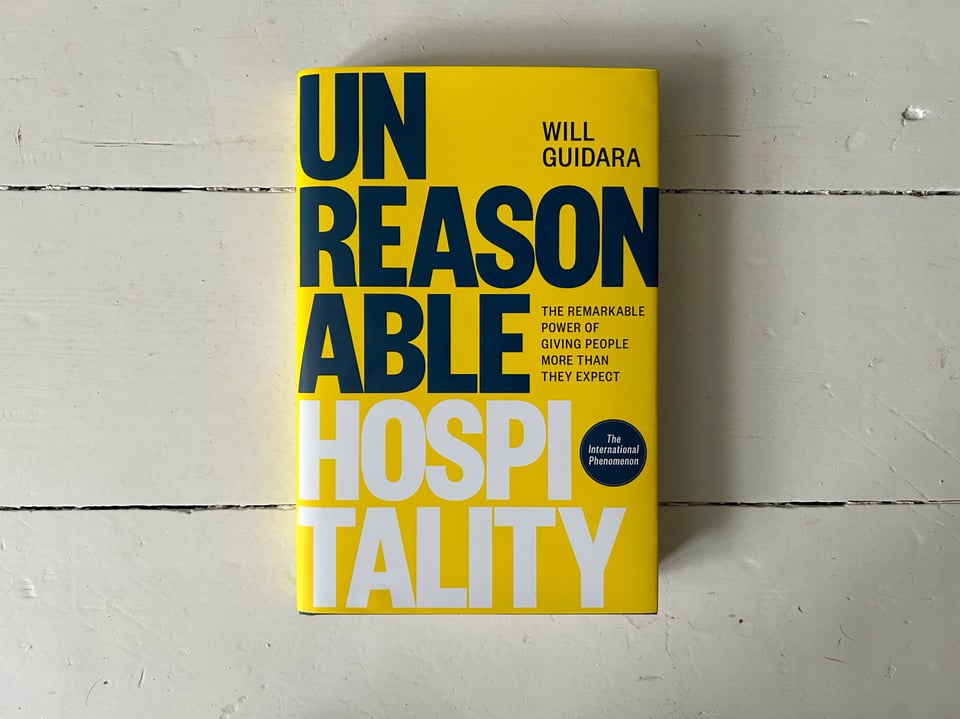
Unreasonable Hospitality
I’m about half way through this book at the time of writing. I knew I was going to like it, but he had me from Page 19 where he describes working in service as a noble calling. I’ve always felt that way. The first agency I worked at used to conflate service with servility, which was obviously stupid, even to a lowly graduate trainee.
The book is full of lessons learned in fine-dining restaurants that can be applied to any business. A lot of it is about the benefits of making people feel like stakeholders, and how to bring that about.
While it may be impossible to quantify in financial terms the impact of making someone feel good, don’t think for a second that it doesn’t matter. In fact, it matters more.
Will Guidara, Unreasonable Hospitality
The invisible forces behind every great company
Will Guidara talks about not being able to measure the impact of making people feel good. Well here’s a LinkedIn article about doing just that. It sets out a framework for naming and measuring intangible workplace forces like curiosity, generativity, psychological safety, and the willingness to dissent. If we can find ways to assign hard metrics to “soft” concepts, these human forces for innovation and growth can be elevated to the same status as EBITDA and cashflow. That’s the theory.

Add a comment: