
Picking up something good
In which there are techniques to get people talking, and I feel sad for anyone who isn’t getting to see David Byrne on his current tour.
(Nothing But) Genius
David Byrne knows how to put on a show. In that, firstly, he knows how to create magic, wonder, and transcendence. And in that, secondly, he knows how to make money from doing it.
As we left Edinburgh Playhouse I overheard seasoned gig-goers saying it was the best show they’d ever seen. That was reassuring. I was feeling the same way, but doubting myself at the same time, because superlative language doesn’t sit well with art. It could’ve just been giddy, in-the-moment hyperbole. I don’t think so on reflection. One of our neighbours - a more seasoned gig-goer than me - said it was the loudest and danciest Playhouse audience he’d ever been part of.
I adore Talking Heads: the lyrics, the moves, the grooves, the aesthetics. (Big fan, personally.) And I’m fascinated by David Byrne as an artist who balances the creative and the commercial without compromise. (Big admirer, professionally.) I’ve gushed about his book - How Music Works - to many clients and colleagues. I’ve gifted a copy to a few. Chapter Seven is devoted to Business & Finances (Distribution & Survival Options for Musical Artists).
Radiohead (the band) took their name from Radio Head (Byrne’s “goofy, Tex-Mex” song). Byrne was chosen to induct Radiohead into the Rock & Roll Hall of Fame. In his speech he praises them both for the quality and innovation of their music and for the savvy, innovative ways in which they’ve marketed it. It takes one to know one when it comes to artists who are creative and commercial in equal measure.
Byrne’s show is the product of his dual creative and commercial vision. It was dazzling to behold but simple to deliver:
Idea 1: Make all the instruments wireless and portable, using harnesses for keyboards and drums, so that every musician can move freely around stage and be part of the choreography for each song. Break the drum kit up and split the components between several percussionists.
Idea 2: Dress everyone in the same clothes, which are all of one colour.
Idea 3: Accompany each song with images, video, and animations projected onto curved, full-height screens that cup the stage. Some of the imagery will be poignant. Some will be witty. Some will be shot on arrival in each city and dropped in at the last minute to give each show a local feel.
The wonder was in the vision. The wonder was in the virtuosity of the on-stage and visual design artists. The wonder was in the unison. There was no need for expensive staging.
I took the crappy photo below as they performed one of my favourite Talking Heads songs, (Nothing But) Flowers. I wrote a love letter to its lyrics (gosh, can it really be?) eleven years ago.
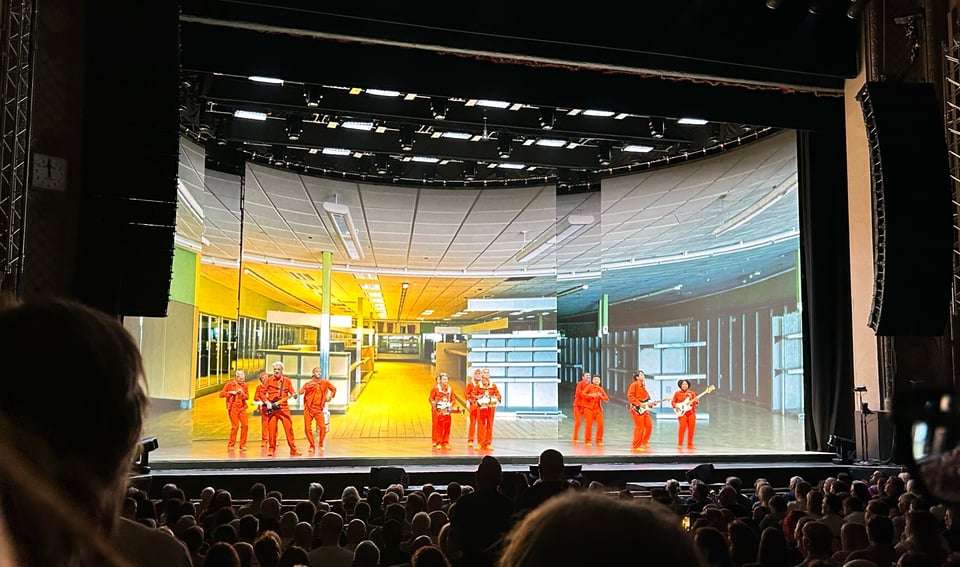
This kind of drifty thing
In the week before the gig I worked myself into a froth by watching Byrne’s Tiny Desk Concert (which features the full tour band in tour costumes), by going to see Stop Making Sense on the big screen for a second time, by booking to see his Sleeping Beauties talk in November, and by listening to many interviews.
This led me to Bella Freud’s Fashion Neurosis podcast. Jeez it’s good. She gives a lesson in how to get an interviewee to open up.
Her guests lie on a couch and talk to a camera that’s suspended above them. There’s no eye contact. It’s an archetypal - albeit achingly tasteful - psychoanalysis set-up. Bella is Sigmund Freud’s great-granddaughter after all. And her couch-side manner is hypnotic.
As Byrne settles on the couch, he says, “You’ll fix me in the course of this.” She replies, “I’ll do my utmost. But maybe you’ll fix me.” It comes across as harmless flirtation, but the chemistry, the connection, the rapport is immediate. Maybe it’s just me, but is there even perhaps a wee hint of the erotic about it? It recalls the strange, unnamed feelings I had as a boy, listening to Hannah Gordon on Jackanory.
Hmmm. Probably just me.
Nonetheless, whatever it is, you can tell he feels it too. You can hear it in his voice as he meekly whispers, “Maybe.”
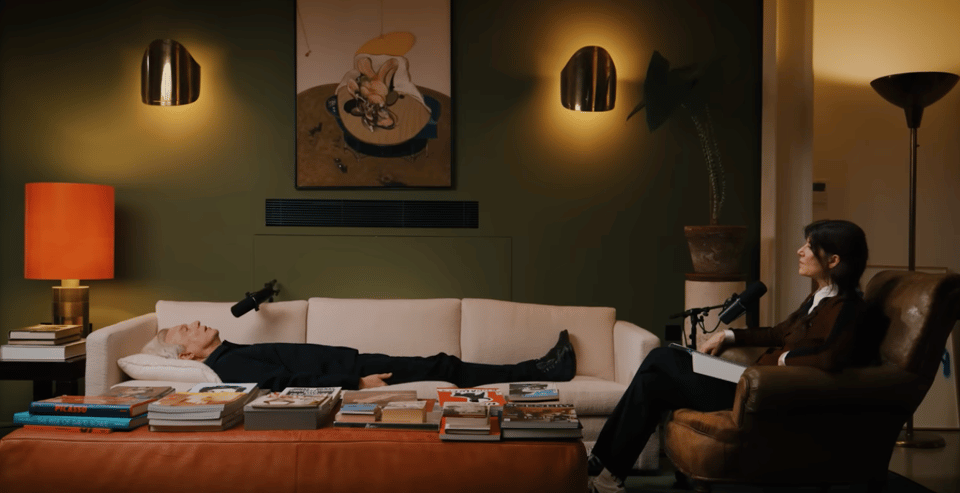
The art of creating a conducive environment. So much of business, so much of life, depends on this underrated skill.
My brand strategy process is embarrassingly simple. Put me in front of the right people and I’ll get them to give me the answer. It’s a process of revelation, not fiction. It’s simple in theory, but creating a conducive environment for a wary interviewee to open up is easier said than done. Bella Freud is a natural.
My pleasure. I feel unburdened somehow.
John Cooper Clarke talking to Bella Freud on her Fashion Neurosis podcast
I’ve watched several of these now. None of the guests are there to sell anything: no new film, no new book, no new album. No agenda. The conversation is the end.
And Freud is an artist. So the atmosphere is playful, whimsical, sometimes arch.
Her guests are artists too, so the conversations take place on common ground. The person in the chair and the person on the couch have shared values, shared references, and a shared language.
Freud has some set questions about clothes that she asks every guest. They have an important role. Clothing is a safe topic that eases her guests into a groove of talking with enthusiasm about matters of identity. Clothes are the gateway subject that make candour and revelation feel natural.
Freud researches each episode with the zeal of a fan. She goes wider and deeper than most, to the surprise (often) and delight (mostly) of her guests. They don’t know whats coming but they like it.
It’s a lovely idea. We’ve had countless meals together and conversations about things. But there’s something about this idea that I saw with some of the other people; this kind of drifty thing that goes on. Just to lie here and talk about things. It’s a unique way to conduct an interview. Good idea!
Nick Cave talking to Bella Freud on her Fashion Neurosis podcast
Early in their conversation, Cate Blanchett describes the strange effect of lying down to talk, and how it makes her realise how much time she spends looking at things rather than listening to them. Her listening is intensified because she’s unable to read Freud’s expressions and body language.
There’s a chapter in Byrne’s How Music Works called How To Make a Scene. It’s about the combination of geography, architecture, sociology, economics, deliberate choices, and happy accidents that placed the CBGB club at the centre of New York’s Punk and New Wave scene in the 70s. Everything had to click, and it did.
Bella Freud has created a scene with this podcast. Intent, idea, style, research, questions, choreography, personality: everything clicks for her and her guests. She has ways of making them talk. And that makes her fascinating.
If you’re liking this, sign up to get the next one.Oh really?
Freud lets slip that she owns a Polaroid that Andy Warhol took of Debbie Harry as the latter lies on her couch. She asks what Harry and Warhol talked about when they were working together:
One of the things I really learned from Andy is that, more than a talker, that he was a great listener. That is a really valuable asset.
Andy. Famous for saying, "Oh really?" That was one of his phrases. And how many ways you can say that. Being present in a great conversation by just saying, "Really?" and wanting to know more.Debbie Harry talking to Bella Freud on her Fashion Neurosis podcast
“Oh really?” It’s not an interview trick. It’s what you naturally say if you’re genuinely interested. Good listeners don’t need tricks. I’m not much of a talker either. I wonder at some people’s ability to make effortless smalltalk. It seems like a superpower to me. In my experience, people who are both good talkers and good listeners - non-binary communicators in effect - are uncommon.
Sudden formality
I spent a long weekend in Paris earlier this month with my filmmaking partner, Patrick, thrashing out a vision for a documentary. It was our first in-person meeting with co-directors, Lia and Salim.
On Day 1 we shared stories about our lives and how we fell into documentary making. We made and ate food together. Salim had brought his own za’atar from Ramallah.
On Day 2 Salim guided us through an exercise for improvised storytelling. Then Lia, Salim, and Patrick presented outline visions for the project, including clips of pre-production film they’ve each shot independently. We brought Lebanese food back to the apartment and talked our way towards a shared concept. More za’atar.
On Day 3 there was sudden formality. We interviewed each other on camera. Each of us was interviewed by the other three, with no prior knowledge of the questions. We put each other on the spot about filmmaking issues of story, style, audience, impact, money, process, and protagonists. We probed each other about personal things: values, politics, ambition, motivation.
It worked. We’d spent two days getting to know each other. It had been intense but informal. And it meant that this sudden formality happened in a context of rapport.
One of the benefits of writing is that it helps you work out what you think. Answering questions on camera has a similar effect, but it’s a pressure-cooker compared to the slow simmer of writing. The interviews fast-tracked the process of reflection and percolation. And it forced us to put into words thoughts that were somehow raw and refined at the same time. I think we surprised ourselves: how much we’d processed in a short space of time, and how we found taut and precise language to express our opinions.
On reflection I realise that this sudden formality has worked for me in my brand strategy interviews. I’ve just never done it in such a calculated, pre-meditated way. Every interviewee has things they want to tell you, most of which have little to do with the discussion guide. But some of it turns out to be more valuable than anything I planned to talk about. It’s good practice to go with the interviewee’s flow to start with. Apart from anything else, you get them to relax and you build rapport by letting them do their “kind of drifty thing”. It sets them up to respond well when things get formal and forensic all of a sudden.
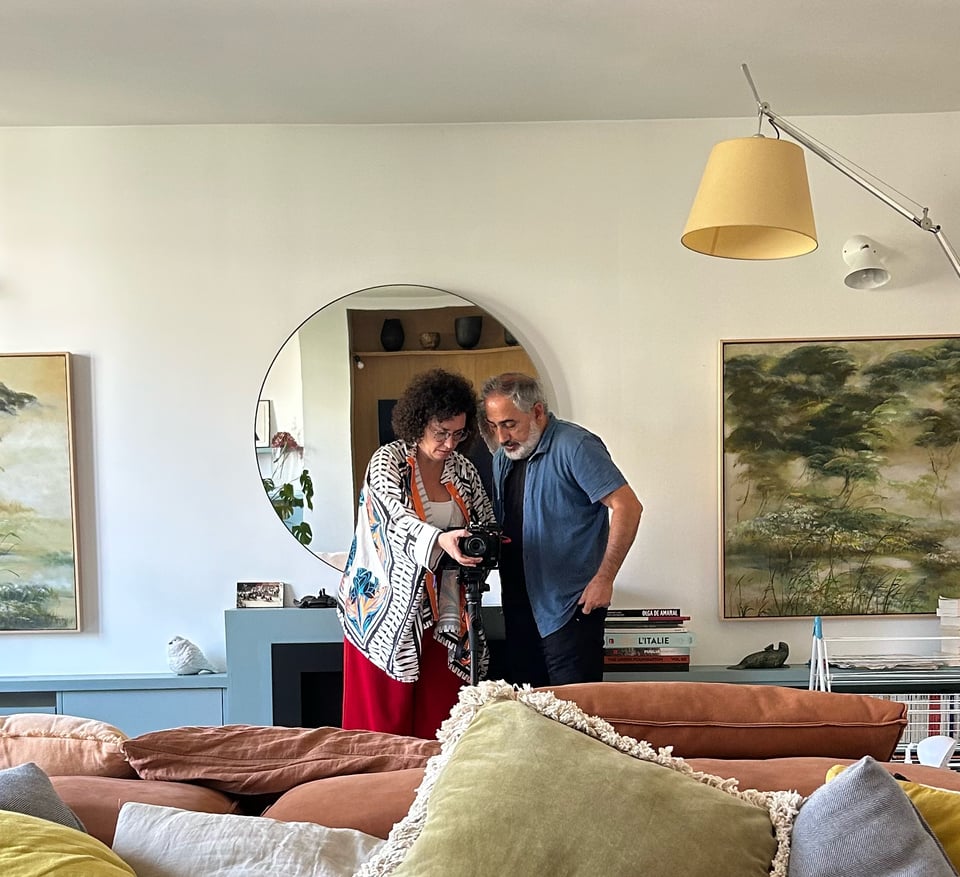
Getting heads to talk
Getting the best out of an interviewee is tricky. I know it’s gone well when they tell me afterwards that it felt like therapy. Like John Cooper Clarke (above), they’ve unburdened themselves somehow.
Bella Freud is a dab hand at this. She even has a couch. But her manner and technique are more important than the furniture. There’s much to learn from watching her and from being the interviewee once in a while.
Going wider and deeper than most people would consider reasonable in your preparation.
Being happy to go off-piste and trusting that the “kind of drifty thing” will take you somewhere interesting.
Gateway topics that get you to the good stuff.
Wanting to know more in a way that encourages people to open up (“Oh really?”)
Sudden formality that forces people to focus and tighten up their language.
We came in on David Byrne. We’re going out on getting heads to talk. If only Talking Heads had a song about the kind of rapport that borders on telepathy.
Baby, your mind is a radio
Got a receiver inside my head
Baby, I'm tuned to your wavelength
Lemme tell you what it saysTransmitter
Oh, picking up something good
Hey, radio head
The sound of a brand-new worldNow, you and I have no secrets
Now, baby, let me read your mind
I hear everything you're thinking
You can tell me what you findRadio Head by Talking Heads
-
Another classic, Phil. Thanks for that. Jim
-
No. Thanks for this Jim. Phil
Add a comment: