
Mint wisdom
In which hard-working brands have things in common with hard-hitting feature writing .
Ads that are upside down.

I posted this idea on LinkedIn last year. It got some traction, or what passes for traction over there nowadays.
My LinkedIn schtick is posts that look like upside down ads, with the headline at the bottom - white out of mint green (#00a8a8) - and the body copy at the top. People hate LinkedIn posts that are advertising in disguise. Their hackles go up.
But they’ll accept posts that look like ads, behave like ads, and don’t pretend to be anything else. They’ll even allow themselves to enjoy them if the upside down ads are reasonably clever, charming, or intriguing. Their guard comes down.
John Willshire once described the posts as “mint wisdom”, which I’ll gladly take, especially from him thank you very much. I’ve sprinkled a few examples across this article.
Cleverness is in the eye of the beholder, but the one above works for me because it’s a straightforward take on brand strategy that’s also a bit lateral:
“It’s very you” means that you’re telling your truth in a way that feels noble and worthwhile. You’ve given everyone in the organisation something to believe in, to get behind, and belong to.
“It’s also very them” means that your brand suits your ideal customers down to the ground. You’re telling your truth in a way that’s irresistible to them. Your brand has charisma.
So this was an upside down ad to say that brands work from the inside out.
Brands that are inside out.
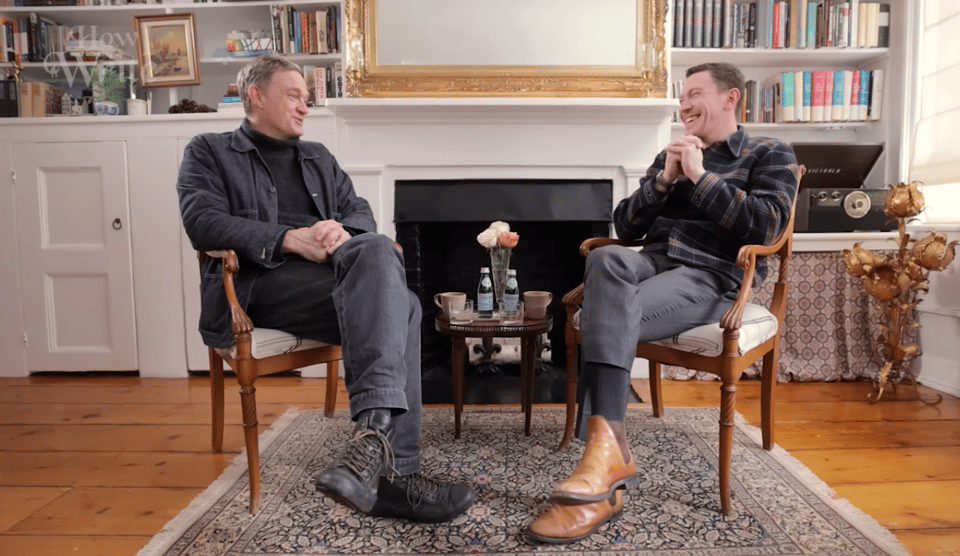
The author and feature writer (most famously for the New Yorker), Patrick Radden Keefe, applies similar principles when he’s writing profiles of public figures. He said this in a recent conversation with David Perell:
One of the things that really matters to me when I'm writing about anyone is that, when I'm done with the piece of writing and people read it, people who knew the person or know the person, that they say, you really captured their essence. You got it right…
I want that picture to be, in a kind of fundamental way, both resonant with people who don't know the person and recognisable with people who do.
Patrick Radden Keefe, How I Write podcast, 8th April 2026
Getting his subjects, and being seen to get them, is as important to him as it is for me to get, and be seen to get, my client organisations.
Resonant and recognisable; Keefe’s profiles have to work for people who are close to the subject and for people who are coming to the subject cold. Like a brand, his writing has to work inside and out.
Uncomfortable is good. Good is uncomfortable.
Here’s another of Keefe’s writing principles that’s pertinent to brand strategy work, even if it’s counterintuitive at first:
Anytime I'm writing about anyone, even if it's something where somebody's giving me all the access in the world, even if it's a generally amiable profile, the experience of reading it should be a little bit uncomfortable for the person that I'm writing about.
Patrick Radden Keefe, How I Write podcast, 8th April 2026
The same applies to brand strategy but for different reasons.
Keefe’s profiles, even the amiable ones, are uncomfortable because nobody’s perfect and it’s their imperfections that make a subject real and interesting. Brand strategy is different. It defines an organisation at its repeatedly deliverable best. But, strangely, that can be uncomfortable too.
If you apply the discomfort principle to my work, it means that my clients should feel a wee bit uncomfortable about their brand strategy. They should feel a tad fidgety about looking and sounding their best. That’s a curious idea and I wouldn’t say it like that in a proposal.
But the common before state for my clients is a brand that’s conformist and underwhelming and not doing justice to how good they are at what they do. As I said to one client whose positioning, messaging, and tone were indistinguishable from their competitors, “Your copy is camouflage.”
The after state is a charismatic brand that’s very them and very their ideal customers. But, by definition, the transition from before to after is a makeover, and the organisation has to get used to the new them. The new them is still them. It’s true and real and sincere. They always had it. It’s just that now they’re flaunting it, which is a new sensation. And they have to get past any self-consciousness. They have to get used to feeling sexy and being noticed.
It might be a bit awkward at first, if you’re used to conforming to category norms to your detriment. But it’s more fun and more lucrative to be sexy in your own skin rather than comfortable in someone else’s.
Meaning always gets mangled.
Another of Keefe’s principles is to be acutely conscious of how his work will land; to foresee how different people with different values will react to and process his writing. He’s promoting a new book just now and doing the rounds with podcast interviews, and he said this to Louis Theroux:
At the tail end of the first Trump administration, I pulled the plug on a piece. I was supposed to be writing a piece about Jared and Ivanka and the kind of weird role that they occupied. And I got a bunch of great interviews, and I was working away on it, and then I was just sort of looking at the way the culture metabolised stories about the Trump administration, and I just thought, what's the point?
Patrick Radden Keefe, The Louis Theroux Podcast, 6th April 2026
He realised that nothing he could write would change anyone’s point of view on the Trump administration. Opinions are entrenched on both sides, with few persuadables in the middle. Rather than prompting people to open their minds, both sides would “metabolise” his writing to double-down on their intransigence. He used the examples of The Wolf Of Wall Street and American Psycho to illustrate how something depicted as egregious can inadvertently land as aspirational.
I love The Wolf of Wall Street. It's a fantastic film. It's doing something that I think is a little too cute, which is that it's ostensibly standing in moral judgment of these people that they're depicting. But in fact, for a lot of people who maybe are kind of unwary or unsophisticated consumers or just teenage boys, it's an aspirational thing.
Patrick Radden Keefe, The Louis Theroux Podcast, 6th April 2026
Brands get metabolised by their audiences just like feature articles are metabolised by society. Put another way, all messages are garbled.

The word garbled comes from old Italian and/or Arabic words that mean sifted or sieved. Based on its etymology a garbled message is one that has had some of its intended meaning sifted out.
On that basis every message is garbled. Every brand is garbled. Garbling is inevitable. The recipient of any message, or the potential buyer of any brand, will sift meaning from it based on the level of attention they are paying and the values through which they interpret the world. A brand that you’ve honed to high resolution lands at lower resolution with your audience. And its meaning gets mangled in the process.
You can’t make your message garble-proof. But you can make your messaging garble-resistant via a combination of strategy and craft. Like a feature writer, be aware that your ideas will be metabolised by your audience, think about how, and proceed accordingly.
Energise, persuade, alienate.
A lot of contemporary political messaging is based on the following principles:
Energise the base.
Persuade the persuadables.
Alienate the opposition.
That third one sounds odd at first, but it’s a safeguard against message garbling. It’s a prophylactic for the mangling of meaning.
The ”opposition” isn’t the other party, it’s the ideologically entrenched hard-core people that you haven’t a hope in hell of shifting. You can’t reach them but they’ll turn your messaging against you if they can. And you need to prevent that for your message to land as intended. Hence the deliberate alienation.
It’s an effective approach and, sadly, populists do it better than the progressives.
“Stop the boats” is a classic example. It alienated me. And it was meant to. But you can bet that it energised the far-right base, and that it persuaded a fair few persuadables.
Keefe is intuitively aware of these “metabolic” dynamics. Every brand strategist should be too.
Rewilding
Keefe has principles that guide his writing. He doesn’t have a fixed process or framework. I’m the same. It makes it harder to “productise” (ugh!) my work. And I don’t have a proprietary process to sell, other than having good ears and a good nose.
I just re-read Richard Huntington’s Feral Strategy ahead of meeting him for breakfast in a couple of weeks. It’s a great read: typically forthright and unusually practical for books of this genre.
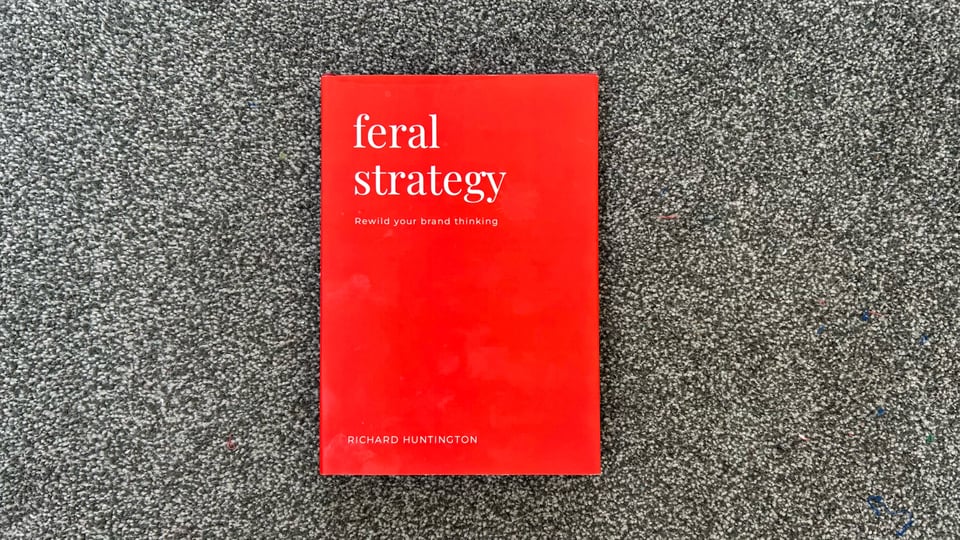
Richard’s all about principles too. He’s no fan of fixed frameworks. In fact he hates rigid adherence of any kind. This is from the chapter on dogma:
Unfortunately, the elevation of theory to dogma happens frequently in the brand advice world, where agencies and consultancies are constantly attempting to steal share from each other on the basis of a new theory or unique methodology.
Richard Huntington, Feral Strategy (Rewild your brand thinking)
Feral Strategy energised me. I’m definitely in Richard’s base. When you refuse to sell a dogmatic process, you risk alienating potential clients who need the reassurance of a template or framework.
Good. Principles for the win.
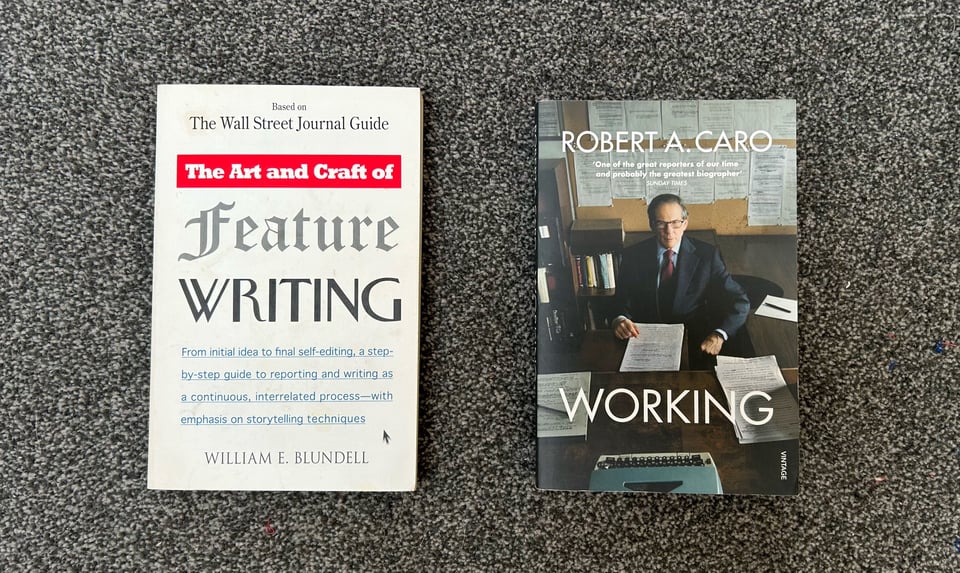
P.S. Brand strategists really do have a lot to learn from great feature writers. So I can’t recommend the books below highly enough. The cover blurb for Blundell’s book mentions a process, but really it’s a collection of principles. I reviewed Caro’s book in a previous edition of this newsletter.
-
This is very you. And also very them. A great read, thank you.
-
Thanks David. We've never met in person, sadly, but a generous, day-making comment like this feels very you.
Add a comment: