
Get with the program
Crumpled, rejected, forgotten. But still funny.
I found these IRN-BRU “roughs” when I cleared out my office recently. They were in a folder of rejected concepts, scrunched up behind some old gadget boxes at the back of a sideboard. They must be twenty-something years old. Old and unwanted. They were knocked back by a suitably unimpressed Barr Soft Drinks client, some time between 2002 and 2004 if I had to guess.
They still tickle me.
The ads are nostalgic (for me) but also topical (for you) because the ad agency Lucky Generals recently launched an outdoor campaign for IRN-BRU. More on that further down.
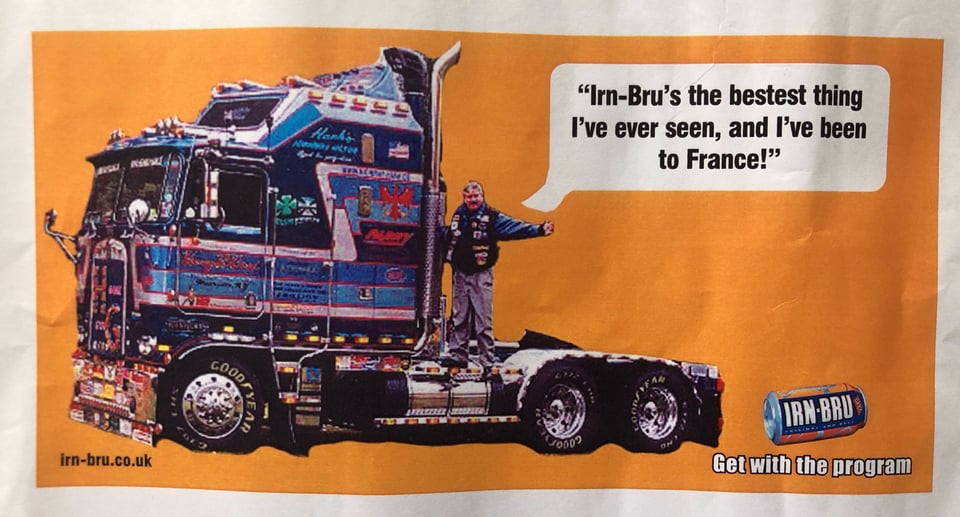
There might have been sound strategic reasons to reject these ideas. I don’t remember. I attended the agency’s internal review that approved them for presentation, but I didn’t go to the client meeting. I was MD at the time if I’ve got the dates correct.
It’s also possible that the client just didn’t get them.
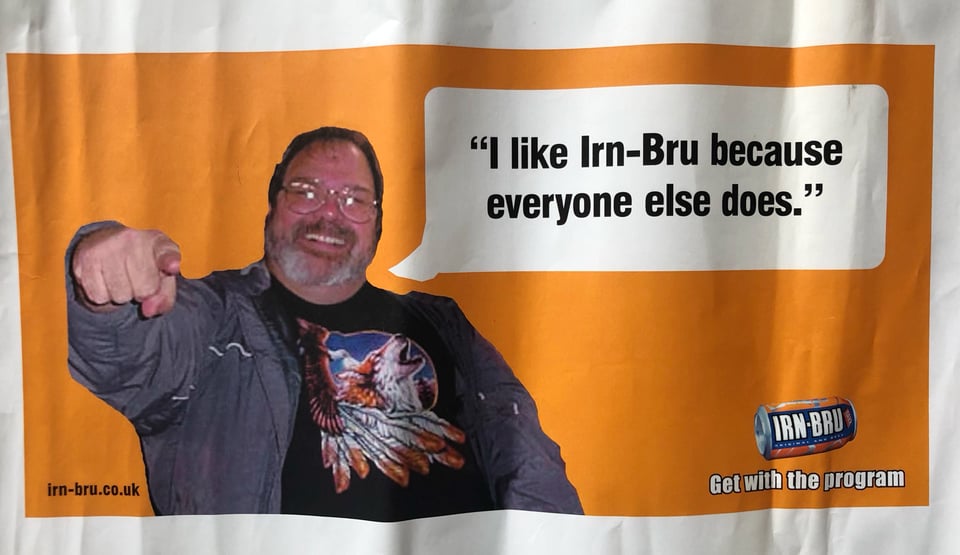
It wouldn’t be the first time that a client and agency were on different wavelengths on matters of creative taste, particularly when it comes to humour. Humour is a toughie. You have to be on the same level. You have to find the same jokes funny for the same reasons, and use the same language to explain why. I once had a client who thought their campaign had “sophisticated wit”. We thought their ads were slapstick.
The creative team behind these IRN-BRU concepts - Chris & Lee, also known as “Chinley & Eric” - were certainly on a different wavelength. They always gave you something unexpected. You never had to push them to be more daring. More often it was a case of pulling them back from being too out there. I’ve no idea where they found the images for these concepts but you can bet their sources were different to everyone else’s.
The Glasgow Uni test
We had an unwritten objective that our posters should have pride of place on every bedroom wall at Glasgow University. You can see that in these rejected ideas. The humour is deliberately studentish. It’s also very Scottish. It’s hard to describe the Scottish sense of humour, but it’s heavy on irony. It’s a country where “Aye, right” means “No, that’s bullshit.” And there are hardly any taboos. It’s a country of frustrated stand-up comedians.
Barr Soft Drinks is a great client that buys great work. Robin Barr (“Mr Robin” to his affectionate employees) knew that the ads weren’t meant for him. He wasn’t supposed to get them. So he always approved the work without demur if his marketing team was behind it.
However, some great work (in the agency’s opinion) was rejected by the Barr marketing team along the way. And it was nearly always because we failed to see eye to eye on humour. Every brand manager - even an IRN-BRU brand manager - has an earnest streak. In their case it was a thin streak. But we put some outlandish ideas in front of them and occasionally found ourselves butting up against this earnestness in a bid to keep the brand fresh and notorious.
Creative teams who were new to the brand assumed that writing funny ads for IRN-BRU would be easy. Their first creative review meeting would soon disabuse them of this notion, as their concepts and scripts were massacred for a variety of hard-learned and quite subtle reasons. One of the toughest challenges was finding the funny-bone balance between clever and mainstream humour.
The notorious B. R. U.
Our ads always had attitude. IRN-BRU is the brand leader in Scotland but it shares very little DNA with a brand leader like Coca Cola. It’s not a happy-clappy wholesome brand. It’s more of a rebel leader. Cheeky. Spiky. Uncompromising. We described IRN-BRU as a likeable maverick. And by playing to that persona we avoided complacency and kept the audience on its toes. We also had a few run-ins with the Advertising Standards Authority (ASA). We conspired with our clients to flirt with notoriety (like I say, they weren’t that earnest). Even before the days of Facebook and Twitter, there was earned-media PR coverage and word of mouth to be gained from being controversial. It was a carefully calculated game. Barr couldn’t afford to have an ad pulled due to an upheld complaint. And this never happened during my time on the account.
An act of patriotism or an act of deviance (the familiarity conundrum)
I worked on IRN-BRU advertising and digital marketing for over two decades from 1994. So I’ve a good idea of the brief behind these crumpled “Get with the program” rejects.
IRN-BRU is two brands from a marketing perspective.
It’s the brand leader in Scotland. Scotland is the only country besides a few Arab states where a cola isn’t the number 1 soft drink. But IRN-BRU’s status goes way beyond market share. It’s a national treasure, an icon, a badge of up-yours pride. In Scotland, drinking IRN-BRU is an act of patriotic duty.
Whereas, in England, IRN-BRU is a niche brand with a weird name and a weird taste. Buying IRN-BRU south of the border is an act of a deviance.
Those market positions would usually require two very different advertising strategies. In England, familiarity is the objective. In Scotland, over-familiarity is a potential problem. However, IRN-BRU has one (limited) advertising budget to tackle two opposing familiarity problems.
In Scotland IRN-BRU is the soft drink guvnor. It’s the cock of the fizzy pop roost. The sultan of soda. It has every right to strut its stuff in its ads. It would be negligent if it didn’t make the most of its market leader privileges.
But its market leader position can also be its Achilles Heel. Over-familiarity can take the shine off a brand. Ubiquity is a commercial director’s dream. But being everywhere and always available can also make your brand feel commonplace and stale. IRN-BRU has to stay relevant in a market where new flavours and new formulae pop up all the time. The soft drink customer has a wandering eye and there are many distractions.
Hence the humour and attitude. Getting the humour and attitude right is the best way to appeal to the Scottish psyche. You can’t take universal pride in a brand like IRN-BRU for granted. You have to continually top it up with clever ads that people talk about.
Whilst you’re fighting against over-familiarity in Scotland, in England you’re doing your damnedest to jack familiarity up. You’re trying to make the brand feel as mainstream and normal as you can, knowing that in reality you’re doing well if you move the needle from “weirdo” to “interesting alternative”.
Hence “Get with the program” at the bottom of these rejected ads. Hence the tongue-in-cheek influencer and social proof messages. The campaign is literally telling English drinkers that the brand is more popular than they think.
Whereas, for the Scots, the ads have brand-leader confidence, but with enough irony and irreverence to protect the brand from being up itself. Hence the oddball, misfit characters. Hence the mild self-deprecation.
The ads are designed to work on two different levels for two very different markets. And I still like them even if the client didn’t.
Marking your territory
And so to the latest IRN-BRU work from Lucky Generals. The campaign showcases a packaging “refresh” in ads that are designed to look like they’re literally made from girders.
(Incidentally there’s more than a whiff of brand management earnestness in the press release language of the linked article.)
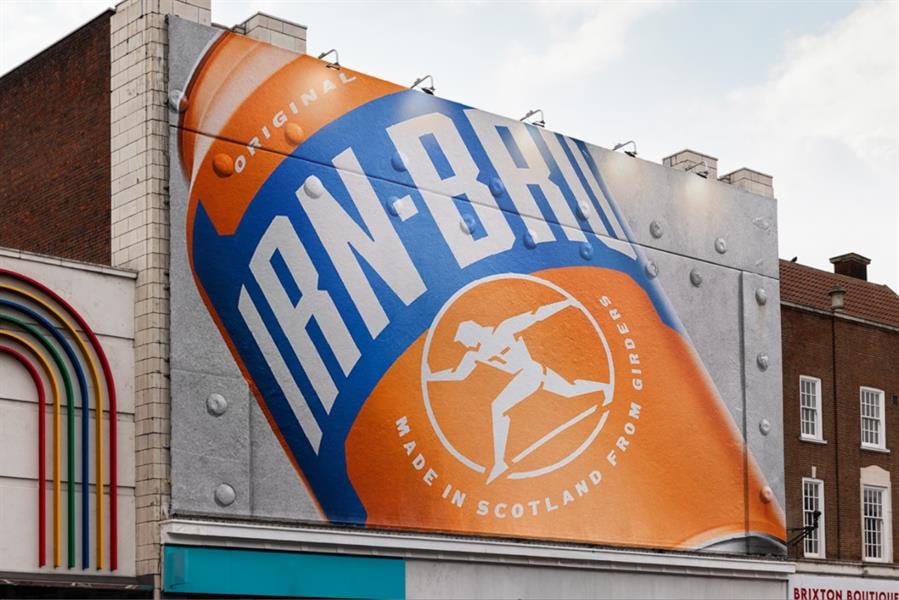
The ads are big and bold and heroic. They are “distinctive assets” on steroids. IRN-BRU is 125 years old this year and, in Scotland at least, it’s marking its territory.
I’ve been on a tour of Iberian cities recently. Much of this newsletter was drafted on train journeys between them. In Porto the big port wine houses like Taylor’s and Dow’s mark their territory with huge illuminated signs that dominate the view when you look from north to south across the Douro River.
And they do the same out in the Douro Valley where they own most of the vineyards. It’s like dogs marking their territory. In fact it’s more like branded colonialism.
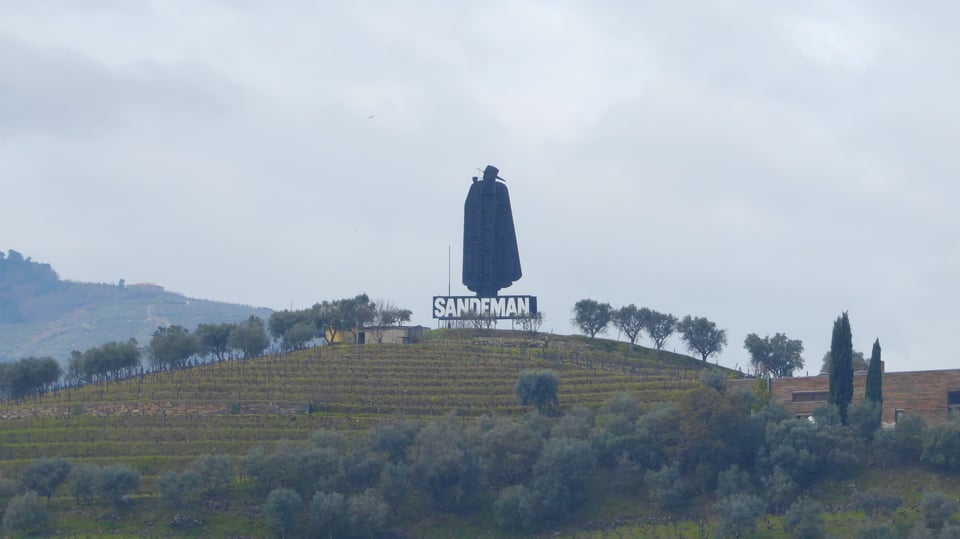
The most striking, and the most sinister example, if you’re so inclined, is the Sandeman silhouette, aka “The Don”. He’s everywhere. And he bestrides the skyline like some narcissistic dictator with a Zorro fetish. The Don is port wine’s answer to The Man from Del Monte: “I am the master of all these here grape plantations that I survey.”
Coincidentally, the original George Sandeman was the son of a Scottish cabinet maker. And the artist who created The Don in 1928 - George Massiot-Brown - was Scottish too. However, he signed the work G. Massiot to capitalise on society’s penchant for French artists at the time. There’s an interesting brand history on the Sandeman website.
Marking territory is what dominant brands do. It’s what Coke does. It’s what Budweiser does. Your ads don’t have to “say” anything. Their mere presence is an assertion of alpha status. It’s the stuff-strutting I mentioned above.
And these new IRN-BRU ads work as territory markers when you see them north of the border: “Welcome to Scotland. You’re not in Coke country any more. This is our manor.”
Glorified pack-shots
I don’t agree with people who say the Lucky Generals campaign lacks an idea. The idea is that the ads are literally made from girders, or at least made to look like they are, harking back to the famous tagline from the 80s.
And I don’t agree that they’re all assets and no attitude. There’s no humour for sure. But the ads do have attitude, namely strength, steeliness, and a sense of resolve.
I do agree that the new ads are glorified pack-shots, but in a good way. There’s nothing wrong with a glorified pack-shot.
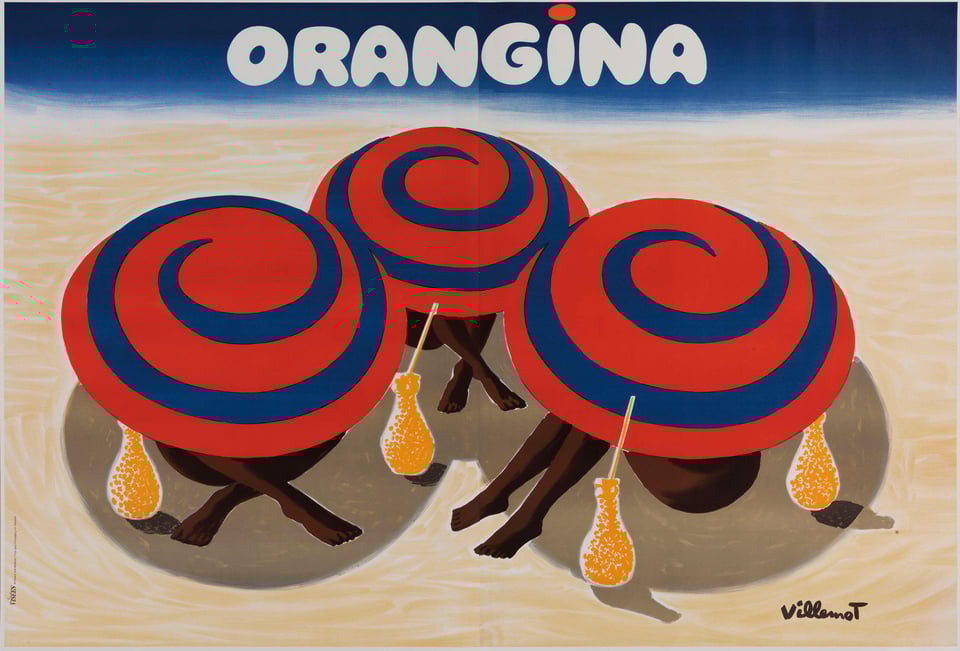
When a pack-shot is glorified by an idea, or by a style or a mood, you can end up with a famous campaign. Orangina knew it. It commissioned Bernard Villemot to glorify its bottle and its liquid with his sumptuous and evocative illustrations. (Unlike G. Massiot, Villemot was genuinely French by the way.)
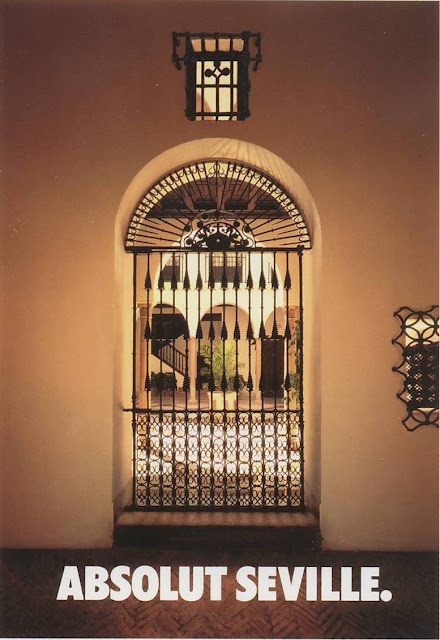
And Absolut knew it too. Their cities campaign (Absolut London, Absolut Paris, Absolut Athens etc.) glorifies the bottle through its absence. And it glorifies the brand through its cosmopolitan sense of style. Here’s a handy blog post with a whole collection of the ads. My favourite is Absolut Rome (Vespa). Absolut Edinburgh (kilt pin) is also cool. But I’ve kept with the Iberian theme by featuring Absolut Seville.
A program people want to get with
Obviously these new IRN-BRU ads don’t hold a candle to the Orangina or Absolut campaigns. They lack Orangina’s zest and allure. They lack Absolut’s wit and panache. But they come from a similar place.
And while they do a territory-marking job for IRN-BRU in Scotland, I’m not sure what they do for the brand in England. They might help with basic visibility and familiarity. But I worry that they reinforce the brand’s off-putting weirdness for the uninitiated. As Mikey Kinlan, an ex-colleague and author of several famous IRN-BRU ads, said to me: “How many youngsters even know what a girder is?” And would it turn them on as a proposition if they did?
That’s the other thing that puts the Orangina and Absolut campaigns in a different league. They’re selling a promise that their audiences actually want to buy. They’re projecting a style to aspire to and identify with. Familiarity is great, up to a point, but charismatic brands create affinity as well. Which is why irreverence has always been vital for IRN-BRU. Which is why I’m glad I found those rejected ads.
If you want people to get with the program, it has to be a program people want to get with.
Add a comment: